Cover for 551st Parachute Infantry Association
1,152
551st Parachute Infantry Association

551st Parachute Infantry Association

The 551st Parachute Infantry Association, originally activated back in 1984, is now re-activated. To become a member email us at info@551pib.us. GOYA!
Comments Box SVG iconsUsed for the like, share, comment, and reaction icons

The Association is excited to know that the lineage of the 551st is breathing new life, through newly formed Multi Functional Reconnaissance Companies in the 101st Airborne Division, as well as the 173rd Airborne Brigade overseas in Germany/Italy. In fact D company 551st has already stood up, which took place on 8 January 2026 at Grafenwoehr, Germany. A, B, and C companies of the 551st Infantry Regiment are being reactivated in direct support of the 3 Mobile Brigade Combat Teams in the 101st with activation dates between 16 June 2026 - 16 July 2026. There is a possibility that activation ceremonies for those 551st companies could take place during the annual "Week of the Eagles" 18-22 May 2026 at Fort Campbell, Kentucky.

If interested in witnessing first hand the GOYA birds of the 551st unfurl their wings once again, the last of the separate parachute infantry battalions that participated in the European Theater during WWII to be reactivated, after being the first to be deactivated on 10 February, 1945, let us know. Keep those dates clear just in case for this historic event in May, and inform the Association of your plans for coordination. More to follow as more details come available to us.

If planning to attend and coordinate with the group please sign up for 551 association membership, so we can keep everyone on the membership informed via email about the re-activation, ceremonies, and any group involvement...GOYA!!
... See More from 551See Less from 551

The Association is excited to know that the lineage of the 551st is breathing new life, through newly formed Multi Functional Reconnaissance Companies in the 101st Airborne Division, as well as the 173rd Airborne Brigade overseas in Germany/Italy.  In fact D company 551st has already stood up, which took place on 8 January 2026 at Grafenwoehr, Germany.  A, B, and C companies of the 551st Infantry Regiment are being reactivated in direct support of the 3 Mobile Brigade Combat Teams in the 101st with activation dates between 16 June 2026 - 16 July 2026.  There is a possibility that activation ceremonies for those 551st companies could take place during the annual Week of the Eagles 18-22 May 2026 at Fort Campbell, Kentucky.

If interested in witnessing first hand the GOYA birds of the 551st unfurl their wings once again, the last of the separate parachute infantry battalions that participated in the European Theater during WWII to be reactivated, after being the first to be deactivated on 10 February, 1945, let us know.  Keep those dates clear just in case for this historic event in May, and inform the Association of your plans for coordination.  More to follow as more details come available to us.

If planning to attend and coordinate with the group please sign up for 551 association membership, so we can keep everyone on the  membership informed via email about the re-activation, ceremonies, and any group involvement...GOYA!!Image attachmentImage attachment

Comment on Facebook

For clarification: Company A will be assigned to First Mobile Brigade Combat Team, Company B will be assigned to Second Mobile Brigade Combat Team and Company C will be assigned to the 3rd Mobile Brigade Combat Team, all of the 101st Airborne Division. Company D has already been activated in Germany assigned to the 173rd Airborne Brigade and will carry the lineage and honors of Headquarters Company of the 551st.

Jessica Arthur

As a veteran of the 101st (STRIKE Brigade) and the grandson of COL Keith Harsh (A/551st), I will be at Fort Campbell for the reactivation of the Battalion.

Philip McDaniel, Dick Wilson, Bob Ziccardi, Martin S. Kaufman

Yes please!

Please keep me posted!

Highest Honor....💖

I am interested.

View more comments

In the words of a mortarman of the 551st PIB...the WARTIME WWII DIARY of Charles Fairlamb. Obtained from the Historical Society of Pennsylvania (HSP) in 2014 and transcribed with permissions. The museum photographs were taken in 2017 at the December44 museum in La Glieze, Belgium.

The GOYA experience of Charles Fairlamb, while he marched along WWII battlefields of both France and Belgium over 81 years ago:

--On April 21, we left the harbor and joined ships from other ports, making up the largest convoy to leave the U.S. to date.
--Our sleeping quarters were on “B” deck, 500 men in one compartment with bunks five deep. The bunks were so close together that we had no place to put our duffle bags except in the bunks with us. We were forbidden to take our clothes off at night and smoking was not allowed. IF you slept on a top bunk, you were bound to step on someone on the way up or down.
--The hatch in the center of the compartment was filled with long tables that were used as mess tables, where you had to stand up to eat. As soon as chow was over, the tables were moved to the sides and the area was used for boxing, impromptu shows, demonstrations and other activities.
--There were salt water showers, and men were required to shave daily. You washed your clothes by hanging them over the side of the ship on the end of the rope. Some got holes beat in them; others were lost overboard. One night there was a fire in the sleeping quarters due to bad brushes on the motor that operated the ventilating fans. It got quite hot when the fans were shut off.
--Every morning there was inspection of quarters – men and weapons. Each morning we had calisthenics on deck, the different companies taking turns as there was very little room on deck.
--Just off Gibralter, May 7, fourteen ships in our convoy were sunk by enemy “subs” which had been following the convoy for several days. Our ship was loaded with “block-busters”, so we were a bit shaky with the thought. Due to the action near the Rock, our ship was forced to leave the convoy and put in at Oran, Africa on May 9, where our equipment was unloaded. During the process one of our nets with seven cases broke, dumping the cases into the water; four were recovered. The day after we left the convoy, they were attacked by dive bombers and three more of their ships were sunk.
--For nearly two weeks we were stationed in a tent camp just outside Oran, waiting for a ship to take us to Sicily. Some of the men sold their mattress covers for $60.00 apiece.
--I had one pass to Oran which is no doubt one of the dirtiest cities in all the world. Shoe-shine boys would run alongside of you and dab what they called polish on you boots; you had to let them finish the job, but when they did, your shoes looked worse than ever. Many of the kids and men in Oran were wearing duffle bags. They cut holes in the bottom of the bags to stick their feet through and then just pulled the rope tight around their waists. Quite a pair of pants!
--We had guard posts all around our camp and every night someone would get a chance to shoot at an Arab who was trying to steal food, blankets or whatever he could. There was an open air theater and open air showers. We had a small training schedule: runs, hikes, and a few problems to solve.
--On May 21, we left Oran on a British ship for Naples, Italy. The chow was terrible; it consisted of lamb stew, bread, marmalade, and some kind of substitute coffee. We slept in hammocks which wasn’t so bad except it was so crowded that you always had somebody’s feet sticking in your face.
--On any ship the most important piece of equipment you have is your life jacket. You keep it with you at all times. You don’t carry it; you wear it. We were also required to wear a stripped down belt with a full canteen of water and a first aid pack. The canteen had to be full; every now and then an officer would come along and give it a shake.
--On the 25th of May, we arrived in Naples and the following day the British ship we had been on was sunk just after it left the harbor. Naples harbor was all beat to Hell! We were billeted in the College of Naples. The buildings were beautiful but had been camouflaged and the floors were hard. We had no beds. We were alerted at this time for the Anzio beach-head.
--On May 28, we entrained in box cars or 40 and 8’s – 40 men or 8 horses. They packed us in pretty tight – 30 men and equipment. The cars were quite short and not very wide; so the first night we tried sleeping with our heads to the outside and feet to the center, but found it was impossible for everyone to lie down at the same time. The men were packed in so close that it was difficult for one man to turn over without disturbing the rest of the men, but nobody really cared whether anyone else was disturbed or not.
--The first night we took turns sleeping and riding on the couplings between the cars or in the brake house on top, or just anywhere a man could hang on. During the day there were as many men between and on top of the cars as there were in them. When we stopped at towns or stations, we would make an attempt at washing, but when four or five hundred men try to wash at the same taps, it gets very discouraging; so all in all there was very little washing done during that trip.
--The next night we hung our shelter halves up and used them as hammocks. They were strung everywhere and in some places three high. There was hardly a night that someone didn’t either fall out or have his rope break causing quite a bit of excitement, especially if he was on the top layer. One man was cut quite badly on his face when an M-1 rifle fell on him. Dixon stepped out of the car one night when the train stopped. It was very dark. The car was on a trestle 30 feet over a dry river bed. He was hurt quite badly but joined us some weeks later. Most of the cars were about 40 years old and the road bead was in very poor shape; it’s surprising we ever got anyplace.
--We passed through Salerno, Reggio, ferried, train and all, to Messina, and finally arrived in Camp Wight on the 4th of June. Here we caught up with “C” Company, which had stayed with the rest of the convoy when our ship put in at Oran. We were told at Camp Wight that five men would not get to see combat. They were right. Five men were wounded during training and one was killed.
--At Camp Wight we lived in tents and spent the first week getting organized. The following week we hiked about 25 miles to the rage where we set up pup tents. Every day we went out on problems and fired all types of weapons. All of our problems were fire problems and the mortars gave close support to the rifle companies as the moved up.
--Leveille and I experimented with mortar shells by making a shaped charge and changing the nose to super-quick and I believe these would have been very successful against pill boxes, but we never had a chance to prove it. I also tried making a screaming mortar shell – it screamed all right, but the stream lining was gone and the shell went end over end and had a short range. We attended a demonstration of troops attacking a pill box by A.B.T.C. (Airborne Training Center) and it was very poorly done.
--Three days later our Unit put on the same show for our own benefit and it was complete with casualties, medics, machine guns, charges placed to simulate mortar fir, B.A. R., radio communications, rifles, hand grenades, flares, pose charges, satchel charges, Bangalore torpedoes. When we finished, the fields were all afire and the pill box, hitherto undamaged from various other attacks, had been reduced to little more than a heap of ruble. A.B.T.C. was slightly annoyed.
--Every night men who were connected with A.B.T.F. training program would go up on the sides of the hills around our tents and send up flares, set off demolition charges and fire rifles and machine guns down over our tents all night long.
--The infiltration course was about 30 yards from our tents. The course was loaded with large charges of TNT (someone got knocked our every day), four heavy machine guns gave grazing fire and a sniper on a high stand kept the men from lagging and also from going too fast by kicking up dust around their heads. On your second offense, he would try for the heel of your boot or your canteen. (Casualties – one or two every day.)
--The following week we packed up and every man had his combat load plus musette bags, blankets and shelter half. The first day we went over a mountain which was brutal; the rifle companies travel light compared to a Mortar Platoon, and they were setting a fast pace. Half way up the mountain we were forced to stop and thought we would never start again. Half the men were ready to pass out and many were so sick they couldn’t stand up. Officers were helping to relieve the men by carrying ammo or parts of the mortar. The whole week was pure torture and 40% of the Bn. Was missing by the end of it. The last night we made a forced march of 25 miles in 8 hours. I had one pint of water in my canteen and my mouth got so dry that when I tried chewing gum all it did was stick to my teeth and the inside of my mouth until I thought I’d never get it off.
--One afternoon during the week we were given patience training and stayed on the side of a mountain in the hot sun; the heat was terrific and there was no shade and very little water. We were not allowed to move around; and although the scenery was quite nice, it got very tiresome. WE could talk but only in low tones. We stayed there from 0800-1800, and all day Tom Holland and I dreamed up a campaign of our own which later on we volunteered for but it never materialized. The idea was sabotage behind German lines with a band of not over 10 men.
--One night on a compass course we hiked steadily from 2100-0600 carrying mortars and ammo over the mountains and down one gorge that would have looked impossible in the day time. When we finally reached the beach we put up bamboo and palm shelters and slept most of the day. We had been on the move for 52 hours. All week we went o without any regard to sleep or chow. We ate whenever we had a chance and slept during ten and twenty minute breaks or whenever we weren’t walking.
--Note: As hard as some of our training was I never regretted any of it because it taught us to go ahead when we were sure we couldn’t take another step and to obey any command given us by our officers, all of which eventually spelled the difference between success and failure.
--After our week’s maneuvers we entrained 3rd Class, later changing to box cars. While we were waiting to leave the station near Camp Wight, we saw a man herding some sheep around a field; then all of a sudden there was a terrific detonation and people went out and gathered him up in little baskets. He had stepped on a mine.
--We arrived in Rome July 1, 1944 and went by truck to Lake Albano, a beautiful volcanic lake with crystal clear water but lots of mines. We could bathe and swim all we wanted. Leveille and I took a walk one afternoon and found a 28-20 spread all over a field. We got a truck the next day and went back and got it, cleaned it all up and had fun firing it. It’s a German anti-tank gun with a tapered bore an a muzzle velocity of 5200 f.p.s. Later when I went to Anzio, I brought back a German 75, cleaned it up and fired it too. One time we fired it out to sea with about 2/3 elevation and got nine rounds in the air at one time.
--We were all given two-day passes to Rome and it was certainly worthwhile. The Red Cross took us on tours and then, of course, we went sight-seeing on our own.
--About July 19, we moved to Lido de Roma and stayed in a beautiful college that had been beat up by the Germans and their bombs. Two planes were still sticking out of the building when we got there. We had quite a leisurely time at Lido and spent a good bit of time swimming after our demolition section had cleared the beach of mines, of which there were many.
--I went back to Anzio and got another German 75 for parts; and in the evenings, we would take it along the beach road and fire it. At Anzio I also picked up enough parts to make up a good M 1, which I started to make automatic and get all the kick out of it. I got most of the kick out but we moved out before I could finish the rest. I also picked up a German stretcher which made a dandy bed in spite of all the dried blood on it. All the parts of the men who died at Anzio had not been buried yet as we found a number of boots with feet still in them.
--One night we were having a problem, a very realistic one with plenty of machine gun and mortar fire. Two men were killed by mortar fire and the next few days, the men were so openly hostile to the mortar platoon that there was an investigation. Then a public announcement was made that the deaths had been caused by 60’s and not 81’s. The night of the problem, I was watching LMG crossfire and saw two tracers hit.
--One afternoon we got all our camouflaged equipment together, camouflaged our hands and faces and were loaded into trucks. We drove through Rome past thousands of cheering people and out to the airport, but we didn’t stop there. We went about ten miles beyond it, where we stopped and pulled a two-day problem. Just about an hour after we had gone through the airport, a large flight of C-47’s took off. The problem didn’t amount to much but the terrain resembled that in France where we were to jump later on.
--Beginning about August 9, we really started to get ready for our jump. It was then that Platoon Sgt. Vicars decided to go on a two day drunk, which didn’t help matters at all. Nevertheless, we did get ready and at 0200 August 12, we loaded into trucks and rode until 1000 when we arrived at a secret airport. We set up our pup tents, and as there was very little else to do, we got in quite a bit of swimming for the airport was right on the coast.
--On the 13th and 14th of August, we were thoroughly briefed with sand tables, maps and aerial photographs. The briefing was excellent. On the 14th they told us we were going to jump in Southern France. That evening church services were held under the trees. It was a very beautiful and simple service.
--On the morning of the 15th – D-Day – they told us the exact location of our jump. Then we had our last mail call. I believe they had been holding our mail for some time so we would all get some. The rest of the morning was spent in destroying envelopes or anything else that contained an address or information that might be interesting to the enemy, and in applying camouflage. Most of the blondes smeared it in their hair; we were a frightful looking bunch.
--More briefing took place and then we had nothing to do until chow time except to count the planes returning from the first lift. One had most of his tail missing and the formation s were quite incomplete. While we were eating chow, one man shot himself but not fatally. I believe he was later court martialed.
--As we finished chow, instead of washing our half mess kits we still had with us, we threw them into a large pit. Then we went back and struck our tents, put on our equipment, and headed for the barn where our chutes were stored. Just as we were drawing our chutes, one man in our Mortar Platoon went crazy and it took three men to drag him over to a jeep and get him to a hospital.
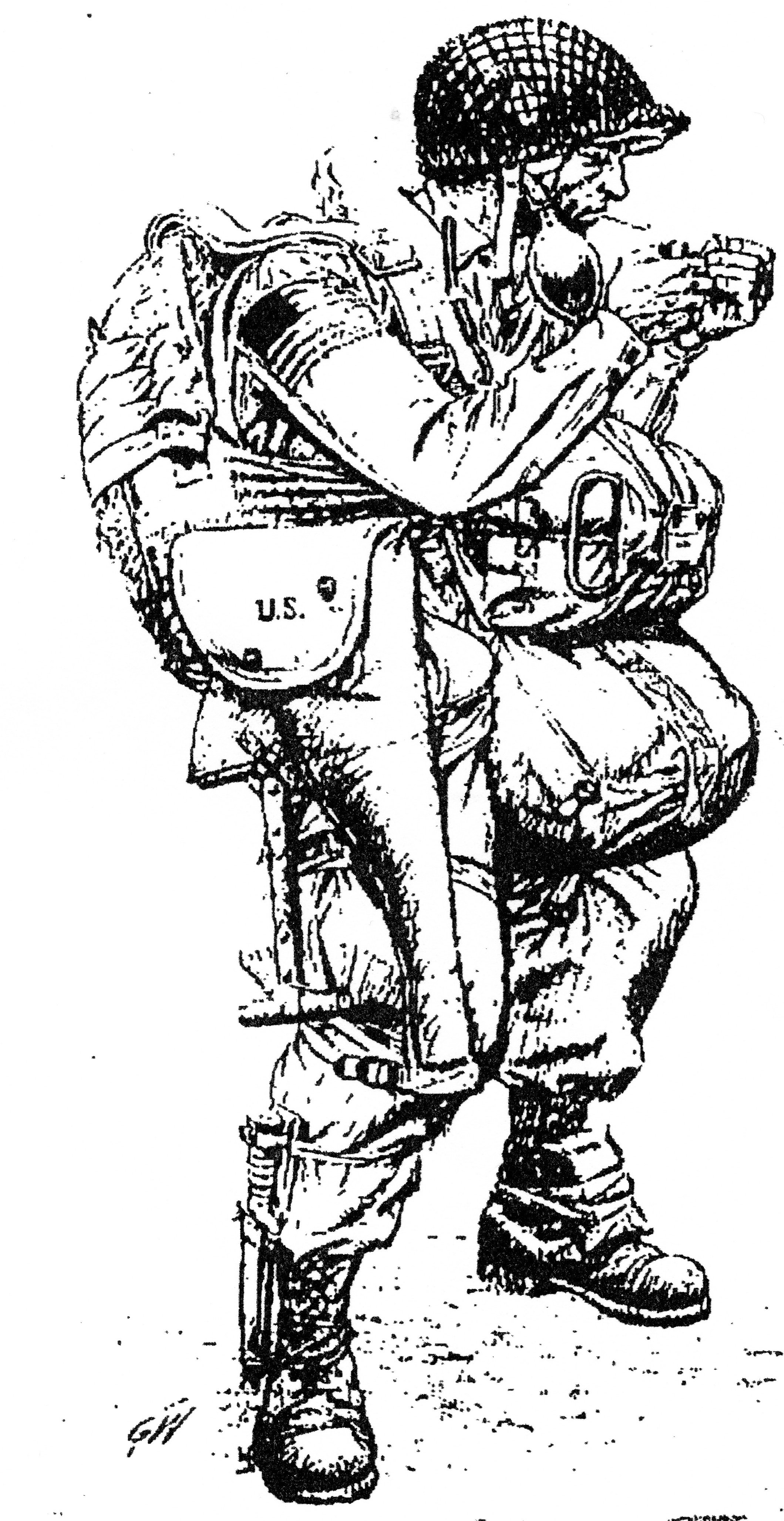
--We loaded on the planes at 1530. The following is a list of what I was wearing and carrying:
1 Wool undershirt
1 Pair of shorts
1 Athletic supporter
1 Belt
1 Pair of suspenders
2 Identification cards
2 Dog tags
1 Pair of shorts
1 Pair of jump boots
1 Jump suit, reinforced
1 Trench knife, on boot
*In left leg Pocket
7 German rifle hand grenades
1 pair of socks
*In right leg pocket
1 Soap box containing soap, razor, 5 blades, 1 toothbrush
1 Medical kit with salt tablets, atabrine, bug powder, sulfanilamide, sulfadiazine, fuel tablets
1 Pair of socks
2 Suspension lines
1 Watch compass
1 Dog tag chain
1 Nail file
1 Watch with cover
*In jump jacket
1 Bible
3 Note books
1 Pencil
1 Fountain pen
2 “D” bars
7 Packs of cigarettes
8 Books of matches
2 Handkerchiefs
1 Comb
1 Web belt and suspenders
1 Lensatic compass
4 Carbine magazines
1 Entrenching tool
1 Shelter-half
1 Pair of field glasses
1 Canteen, sock covering
1 Canteen cup
1 Spoon
1 Cleaning rod
Bag containing:
1 Demolition kit
1 Cleaning kit
1 Firing pin – German 75 mm
1 Firing pin – German 28-20
1 Set of sights for both
8 Packs of cigarettes and matches. Chewing gum
3 “K” Rations
4 “D” Rations
1 First Aidpacket with 2 pkgs. Sulfadiazine
1 Parachute first-aid pack with morphine, Carlisle bandage, tourniquet, strapped to boot
1 Pouch with mosquito repellent, halizone tablets, energy pills (benzidrine sulfate)
1 Gas mask with 4 eye shields, 1 eye ointment, 1 K-4 ointment
2 Gas covers
1 Utility bag with 2 smoke grenades, 2 fragmentation grenades, and 100 rounds of carbine amino (Total 160)
1 Carbine with pouch and 2 magazines
1 Radio 536
1 Steel helmet with net and CO2 and chin strap (parachute)
1 Five gallon water bag
1 Burlap sack (sand bag)
1 Message book
1 Mae West
2 Tubes of camouflage paint
1 Chute, Main #903314
1 Chute, Reserve #42100314
The total weight was approximately 150 pounds.
--After training together for over a year the 551st and the 550th were split up and were never in combat together.
--Take-off time was 1550. There was some tension but not as much as I had expected. One man got sick in the plane but waited for the crew chief to get him a bucket, which was fortunate as the floor gets very slippery; and it makes a big difference as to how fast you can get out of the plane.
--At 1800 we came over the coast of France; and at 1807, we went out the door. There was some flak as we came over land and plenty of smoke and fires and artillery and small arms fire.
--I jumped second man in the 23rd plane. On the opening shock my radio broke loose and I caught it by the strap but the batteries were gone and so too were the top and bottom of the set. I landed in a grape vineyard and broke a rib when I landed on my canteen.
--The last man in one plane, a medic, failed to jump and was later given 30 years. Had he been an infantryman he no doubt would have been shot.
--Our coffee and doughnut bundle dropped too far into German territory to be recovered, but the Red Cross joe had a bottle of Scotch and anybody that went past him got a taste as long as it lasted.
--There was very little opposition on the field. One or two were shot on the D.Z. and one man I saw had landed on a post and torn his butt up rather badly. The saw-bones was sewing it up when I went by and was grinning so I guess everything was O.K.
--The gliders came in at 1817 and I’ve never seen a more awful sight in my life. Some of the gliders lands up-side-down, some on one wing, others crashed into trees. I saw one jeep come out of a glider while it was in the air, and another come through the nose when the glider hit. All in all it was a very sickening sight.
--We relieved the 3rd Bn. Of the 517th P.I. at 20:00 on the 15th of August and the next day, D plus 1, we were resupplied by air and attacked Draguignan. Our casualties so far were very light. D plus 2, we took Draguignan after one of the most grueling marches I’ve ever been on. Instead of going up the road into the town which was about a mile, we went around on the flank and up and down terraces. We got into town at 02:00 and the men could hardly stand up. It was pitch dark and we hadn’t made a sound getting into town. Parties were organized to round up the Krauts and that night we rounded up 500.
--About 04:00 we lay down in the streets to sleep. Imagine the surprise of the inhabitants when they came out in the morning and saw their town full of G.I.’s. The people were wonderful to us, kissed us, hugged us, and cried all over us. We were a very sorry looking sight after only two hours rest. The women, however, came out, mended our clothes, brought us water to wash in, and did everything they could for us. They had had no idea we were coming until the afternoon before when we had quite a battle on the outskirts of town.
--We set up our mortars in the town square and fired all day and night. Snipers were very active on the roof tops but no one paid much attention to them. Most of the Mortar Platoon was lined up along the curb when the first tanks came into town. They were sure they were the first and had quite a good reception; but when they got to the square and saw us, their faces dropped. Nevertheless we were cheering as loudly as the civilians.
--Leo Urban and I were told to go out and set up an O.P. which we did. We picked a large building and lay up on the roof, but no sooner had we done that than we were fired on from the rear as we had gone quite some distance through the Kraut lines and it was some hours before we were rescued. We sure sweated.
--On D plus 4, we marched all day to Le Muy as the 36th Div. on a hill just west of Cannes. They had been sitting there since D-day and five minutes after we arrived they got their first shelling. It was really something. The Germans shelled us all afternoon and night without stopping. Our job was to hold the position but the C.O. of the 509th on our flank moved up so we had to move also.
--P.I. Ellis was hit and died 14 days later. He was the first casualty in our Mortar Platoon. Leo and I spent two days and nights in the O.P. which was a shallow one-man slit trench. One shell hit two feet from the trench and I never woke up.
--On D plus 8, we attacked hills 101, 105 and 106 and were shelled by German 80 mm mortars, 75’s, 88’s, 155’s, and 240’s. When we took the hills we found over 150 dead Germans that we had killed with our own 81’s. We consolidated our positions and moved one section of mortars into Les Termes to support an attack made by the 509th. We were shelled out but the 509th got our first and left us high and dry.
--D plus 10, I took a bath in a helmet. It was wonderful. The Navy has been giving us excellent support with 14” guns. Dive bombers attacked the Germans’ big guns but couldn’t knock them out as they were in the side of a mountain, and the Germans rolled the guns out on tracks when they wanted to fire.
--D plus 11, we moved through Cannes to the N. E. and took up positions at Mongins. The next day we moved on foot again to new positions south of Biot and set up our C.P. in back of an ex-Gestapo Hdqs. In the front of the building as our O.P. and two LMG’s.
--An unarmed machine gunner, about 20 yards in front of our positions, was captured by a German officer and four men. While he was being questioned, a hole appeared in the officer’s head, and up came a wild looking Frenchman. There was quite a scuffle, which resulted in five dead Krauts.
--D plus 12 we marched about six hours to a point south of St. Laurent along the Varr River. This was to be our final objective and we were very glad as we had very little rest and still hadn’t had any supplies brought up, except for what we could carry with us.
--That night and the next the Germans shelled us with artillery and mortars; then sent 50 man patrols through our lines and tapped our wires. It was very uncomfortable, especially if you were out laying wire. The reels make so much noise.
--On the 28th of August our Bn. Liberated Nice. We didn’t stop but went up the mountains past Nice to a point near Condamine. We thought this was to be a rest, but it turned out quite differently. The following day we received quite a shelling. This was the first chance I had to wash my clothes since the 10th of August.
--Two cooks who had just arrived and gotten off a truck were wandering around when Germans started shelling again. Quick as rabbits they both jumped into the same slit trench. When they came up, they were the sorriest looking sights we had ever seen; we all nearly died laughing for they had jumped into a latrine.
--In the late afternoon of the 29th we moved both sections of mortars up to Fort de la Revere and shelled the town of La Turbie just above Monaco. We were also on the receiving end of a good shelling and had to move back to our old positions about 0300 the following morning.
--That night we moved two mortars up to the Fort again and in three hours had fired over 800 rounds on La Turbie. American dive-bombers attacked the forts on top of the mountains. This time the Germans had our range and knew where we were and we couldn’t get out until 0500 the next morning.
--On September 1, we took La Turbie after some scrap and we set up our C.P.-O.P. on an observation platform overlooking Monte Carlo. Just above us and in very plain sight was another fort, held by the Krauts. All night long, they fired but most of the shells landed on the edge of Monte Carlo. Our artillery also fired all night long and the Navy kept up a steady barrage of 16” shells. We thought perhaps the Germans had moved out of the fort; so a French patrol went up to investigate. If the fort was cleared, they would show three white lights. We watched all night long but no lights appeared, and the patrol was never heard from again.
--On the 2nd, the First Special Service Troops relieved us. Later they got kicked around just a little ways up the coast at Menton.
--From La Turbie we went by truck up the Varr River to a spot called Villars. We were not in the town, but down by the river in a beautiful spot with mountains all round. We had the next few days to lie around, bathe (the water was icy), eat and relax. It was wonderful and there were no details.
--On the 6th, ten of us moved up the river to Puget-Theniers and from there ran contact patrols to Barcelormette to contact the 550th. It was about 80 miles by road over the mountains.
--Two days later we moved out by truck and occupied the towns of St. Saveur, Isola and St. Etienne. One section of mortars was in St. Etienne with “A” Co. and my section was with “B” Co. in St. Saveur. We set up to defend the town. The only location for an O.P. was a church steeple, but shortly after we moved out the Krauts knocked it down.
--On the 15th, part of us moved up to St. Martin-Vesubie and relieved the 509th P.I.. We set up our guns and the section moved into the Hotel Victoria. It was heaven. The first snow in the mountains came on September 20. The other section of mortars moved up with us and we had a Frenchman cooking for us. We were loving quite a life. Every night we would fire the mortars, then sleep late in the mornings. We took turns manning the O.P.’s and going on patrol.
--It’s the 23rd of September, and we now hold the record of being on the line longer than any other airborne outfit – 39 days. We’ve fired approximately 4,700 rounds of mortar ammo. Every day patrols would go up the valley and just about every day they would be ambushed. One day after another ambush, it was decided that we would go up the valley in force with mortars and 42’s, which had just moved in, drive the Germans out of the town at the head of the valley, booby trap it and move back the same night. When I joined the patrol part way up the valley, they mistook me for a Kraut and I thought this is the end.
--We accomplished our mission and decided to stay all night and continue 15 miles farther the next day. The rifle company was relieved but not me. I was forward observer. The night was one of the most uncomfortable I’ve ever spent. Snow on the ground, continuous could rain, no chow, now overcoat, no raincoat, wet feet and no fire. We had to stay out of the buildings as they were already booby-trapped.
--The guns were displaced forward and two of our men were hit by booby-traps. The next morning the Colonel’s jeep hit a mine and Buchaine, the driver, was killed. One E.M. and a Lt. were seriously injured; fortunately the Colonel wasn’t in the jeep at the time.
--On the 15th of October, the 1st Section went to St. Saveur and my section moved to Dalmas, which was about 10 miles from our nearest troops, which were at St. Etienne. This was obviously a mistake on the C.O.’s (“A” Co.) part as there were no riflemen with us or near us. Leveille and I made a few patrols up the mountain but couldn’t find anything. We had no communication with the rest of the outfit and no transportation.
--The next day they came up and moved us back to Isola, which was a small town in a valley with high mountains on either side, that was being held by one platoon of “A” Company. Two days after we moved out of Dalmas, the Germans moved in.
--Eight German pill boxes on the tops of the mountains were clearly visible, making us quite uncomfortable. At that time Isola had been shelled steadily for the past 15 days. When we arrived we learned that two T.D.’s had been there but every time they got out where they could fire, the Germans shelled them out; so after about 10 days, they were forced to leave. Next the 42’s had come up but never succeeded in getting their mortars off the trucks and set. The Lieutenant then told us he didn’t see why the C.O. had ever sent us down there, as we were sure to be knocked out the first day. Nevertheless, we dug our two positions in full view of the pill boxes, the only location we could find that was suitable, set up our mortars and started to zero in on them. After the second round, the Krauts rained 107 shells on us but never scored a direct hit. We were now in and ready to operate.
--We were living in a house that we had fixed up rather comfortably, but had to spend most of the next 30 days in the cellars, which were lousy with rats. To get into the town, we had to cross a bridge, which was the Krauts favorite target, and the town itself was getting more and more holes in it every day. Most of the time we stuck within a few yards of the house and only went out for wood, coal, and to pick up our rations. The trucks came through Isola as though it were a race track. They threw the mail sacks off on the run. The only trucks to stop were the ration trucks and the pass trucks. After one trip on the pass truck, no one wanted a second as the shelling was too heavy and too accurate on the lower bridge.
--Blackout regulations were not observed to any great extent, so we always used flashlights when we went down to the guns at night. There were only about ten civilians and a few Italians left in the town. On the 27th one civilian was killed and one Ginso wounded. Our casualties so far were one killed, one wounded.
--We operated an O.P. on the opposite side of the valley, which was T-shaped, and to get to it one had to cross the first bridge, go through the edge of town flanked by fields, across a foot bridge over the Tinee River, and up a winding, narrow trail to the top or rather a shelf on the side of the mountain. All the way the land was pockmarked from shells and the trip up took an hour. It was a sweat. On one of the trips up, I was about two thirds of the way up the trail, when they sent in a terrific barrage. As there was no place to hide, I lay flat on the trail, which was right on the face of the mountain with a sheer drop on one side. Finally it lifted and I stopped praying and went on up. On the way back that afternoon, about 100 yards below where I had been, the trail was missing. Also on the 27th a Special Service truck, rushing to get to St. Etienne, was hit about 200 yards below the C.P. The Germans shelled it for nearly two hours while the occupants hung down in a well. We finally got the truck towed up the road, all the tires were flat, holes were all through it, and in the trailer was a generator with a radiator that looked like a sieve. It was a movie outfit, quite disabled; but after tearing the rainspouts off the house, we piped a stream down to it and kept enough water running through it so it worked O.K., and we were all set to have movies. Just as the show started, we were alerted and had to fire the mortars for 45 minutes. We did see the show after that, but no sooner did we get back to the house at 2400 that we were alerted again and fired until 0300.
--There had been a lot of close ones and the C.P. had many holes in it, but on the 28th all was quiet. Then on the 30th we got a terrific pasting. It was the worst we had had and we were all upstairs in the house and couldn’t get out to get to the cellar. We all knew the next one was going to hit. Finally one came that blew all the windows out and another that sent shrapnel all over the room.
--On November 4, as we hadn’t been shelled for three days, a 15 man patrol was sent up the valley. All were pinned down; they had five casualties but none was killed. About this time we learned that we were up against some of Germany’s best Alpine troops.
--The shelling is beginning to tell on the men. German patrols come down into town, and we have only about 15 riflemen and 14 mortar men. We’ve killed, wounded, and captured our share of Germans while we’ve been here; but I think if the shelling keeps up much longer, some of the men will go crazy. There is no place to go and nothing to do but wait for them to shell us some more. One afternoon as we were all sitting in the house, the boy who did the cooking for us started to whistle, then the door slammed. When we got up off the floor, I thought someone was going to kill him. We could never break him of the habit of whistling.
--The shells the Germans were using were mostly rockets with a double burst: the first burst gets the shell inside the building, then the shell explodes. We have fired the mortars nearly every night, sometimes firing as close as 300 yards to our house. One night we were told to bring the fire in closer and closer until the shrapnel from our own guns was hitting our house and C.P. They brought us warm snow pacs, which were marvelous. It was a good thing because it snowed that night of November 14.
--The Battalion is holding a 55 mile front, and there are many miles between the towns. The best we can do is keep the trucks and jeeps going over the roads. But every now and then one of the jeeps will disappear, men will get lost while on patrols, and we never hear from them again.
--Our mortar platoon has been expanded to 8 guns and one patrol gun. One gun is mounted in a trailer, and we go along the road firing into the mountains. It’s great sport.
--On 15 November, we took one mortar and 72 rounds of light and 12 smoke with ten riflemen and went 3000 Yards up the valley into German territory and fired on the pill boxes and other positions. The Krauts got on our 536 wave band and tried giving us fire orders. We burned down the town of Planet, then moved out. That night we fired the mortars again and got shelled.
--The next day one of our patrols was ambushed, but we rescued them with mortar fire. We fired again in the night and set fire to six more buildings up in the valley.
--November 18 was a great day – we were relieved by the 100th Infantry. We had been on the line for 96 days without a break. To date only one outfit has stayed on the line longer; that was the one at Anzio that stayed for 97 days.
--We moved to St. Jeannet, where we set up pup tents on terraces; each terrace was wide enough for one road of pup tents. We have a very relaxed training schedule. In the morning we stroll along the road, meet some of our buddies and chat. Every afternoon and evening we have off. In the evening we sit around a fire, drink coffee, and talk. There are usually five or six men around each fire. We are enjoying it very much, even though the nights are cold.
--On D plus 15, the Southern France campaign was between 30 and 60 days ahead of schedule. Our Battalion was 10% of the Airborne Task Force, but we had only 3% of the casualties and captured 23% of the prisoners. We never had to withdraw and never failed to take our objective.
--On the 20th of November, I went to the 78th Station Hospital for a stay of ten days.
--December 8th, we boarded 40 and 8’s once again. This time it’s cold, and we are packed in, 25 men and all equipment per car. This includes duffle bags, barracks bags, and mortars. We have a sand box to build a fire on, but it takes up too much room and smokes too badly. Finally we threw it out and stole a stove out of a caboose, when we stopped in a yard. The stove came complete with fire, but still the trip was very uncomfortable. The car in front of us caught fire one night, and we could see stuff going by our door as they were throwing things out. Soon a big bundle came past; it was a man in a sleeping bag, who had caught fire while he was asleep and hopped out the door. The train was moving at quite a clip, but a medic and a corporal found him the next day and he was all right.
--General Gavin was at the station to meet us at Reims. There we loaded on to trucks and were taken to the old Cavalry barracks at Laon, where we then became part of the 82nd Division.
--At 0200 on the 18th of December, we were alerted for the Belgium Bulge with a six hour notice. It’s the same old story; we’re just a Battalion and it takes too much paper work to get us moved. Besides, we never have enough transportations of our own.
--So on the 20th we were alerted once again. This time we had to be ready to move out in one hour and we did. It was a mad-house; nearly eleven o’clock at night with very few lights, we were drawing equipment and loading trucks and trailers as fast as we could. The convoy that left in the morning was badly strafed and rumors were anything but pleasant.
--Some of the men were quite sick. The cooks made us coffee and that helped some. We were given a code for maps – JPRZADVXTL – and a briefing: “If anything happens the convoy won’t stop; if any trucks are disabled get them off the road if possible; try to catch the last truck, an empty, if not proceed to Werbomont the best way you can. It’s near Leige, Belgium.” The prospects weren’t good. All the machine guns mounted on the cabs of the trucks were manned, and all rifles were carried loaded. We moved out at 2345.
--The two trucks following ours turned over, and the convoy was split up. Our truck and one jeep were the only vehicles to arrive at the designated spot. The Colonel had gone ahead some hours before us but had been misdirected at the bridge by two Krauts, who spoke English and were wearing G.I. uniforms. At the other end of the bridge were two Americans. It was a dark, cold night.
--We arrived at a place near Werbomont at 1300 on the 21st of December. The rest of the trucks came in by eleven that night. We had been driving blackout. That night we all slept in barns in some little town. It may have been Werbomont, I’m not sure.
--The following day, we moved up as front line reserve and dug in. It was miserable, plenty of snow. We had to dig slit trenches, but they would fill up immediately with water so that it was impossible to get in them unless an emergency arose. We dug mortar positions and set our guns up on the outside, picked our target and called it a day. It was too cold and wet to do much sleeping.
--The 23rd of December dawned bright and clear and cold. The bombers came out by the hundreds. Fighters were also very active. We watched the bombers in perfect formation go over their target, drop their bombs, make a wide arc and return. The flak was very heavy, and many bombers were shot down. We were strafed which resulted in two casualties. Many enemy fighter were in the air. Although the day started out clear, the vapor trails many miles long soon clouded the whole sky and remained there the rest of the day. It seemed as though there wasn’t a time that you couldn’t look up and see chutes in the air.
--At 1500 on the 24th we prepared to move out. Everything was set for us to move through the lines and attack dug in tanks and fortified positions along the river. Our Officers told us that when the Infantry heard Paratroops were coming through, they cried, they were so happy.
--We were attached to the 7th Armored Division, and the plan was to attack with tanks as support. From all reports it was a suicide mission. One Co. C.O. said he felt he would be lucky if he could bring five men back with him.
--The jump off time was 2230, but at 2000 the attack was called off and we returned to the barns of a few nights ago. It was certainly a wonderful Christmas present.
--Christmas Day in a barnyard: Dinner consisted of one can of Meat and Vegetable Hash, frozen solid and no way to heat it. Later, we were attached to another outfit and moved around to another point in the bulge. This time the north side. Spent the night in a vacant house; it was right nice.
--On the 26th we moved up to some woods and dug in as front line reserve. Every time they found a weak spot they seemed to move us around to it. The woods were as dark as the inside of a cat, and the blackout was strictly enforced. At about ten in the evening, the cooks brought us our Christmas dinner: turkey, cranberry sauce, string beans, and coffee. It was fine but strange for I had never eaten Christmas dinner in the dark before.
--We slept in the open slit trenches. It was impossible to see anything in the woods at night and the only way you could get around was by calling to someone. You were forever walking into trees and falling into holes. One man got a broken nose when someone walked into his trench. The snow keeps getting deeper. It’s miserable.
--On the 27th they planned a night raid for us. We werer to go through our lines at 2300, take two strong points, advance 3000 yards, drive the Krauts out of a town, and return through our own lines by 0500. It sounded bad, especially when we were informed that no American patrols had been through the area, so we didn’t know what to expect. Then to top it off, General Gavin came up to our area and informed us that it was suicide and we probably wouldn’t make it back. We were to make it sound like a big scale attack in order to take the pressure off the lines elsewhere. He also informed the medics that they would have the toughest job of their careers as the only means of transportation would be litters.
--When the General left, our officers told us that all the wounded would be evacuated somehow. Then came to move out and we put our overshoes, overcoats and musette bags in our fox holes. Then with blackened hands and faces, we moved out. At exactly 2300 we went through our front lines. All afternoon our artillery had kept up a steady barrage. They lifted it just 30 minutes before we passed through. “A” and “C” Co.’s were the attacking companies and Rex and I were with “A”.
--We started across no-mans-land; as we did, the Germans started pouring in the artillery. By this time they must have known that someone was coming but didn’t know from which point, so they kept traversing with their guns. We kept a 15 yard interval, and there wasn’t a sound except for the shells bursting. The moon was quite bright; we stayed close to the edge of the woods. Next we went down a wide slope and across a small stream. All the while the shells kept coming. Then we crossed an open field that was quite wide and loaded with mines, but as the ground was frozen none of the mines went off. Next we crossed over a paved road and into a big ditch was about 10 or 12 yards wide and over 5 feet deep and only a few feet from the road. In the ditch was a stream and a number of trees and shrubs. By this time we had passed through the artillery fire and were getting the mortar, but the Krauts still didn’t seem to know quite where we were.
--As we moved up the ditch, we could hear a tank or tanks rumbling up ahead, and the C.O. put Bazooka man on the road: one on each side and one on the end of the road. As I came up even with them, they were motionless, but this is what I heard:
1st Bazooka Man: “Hey Bill, be sure not to fire too soon.”
2nd Bazooka Man: “Naw, I ain’t gonna fire too soon.” (Pause)
1st Bazooka Man: “Hey Bill, wait till he’s right up close and then fire.”
2nd Bazooka Man: “O.K. – O.K.” (Another pause)
1st Bazooka Man: “Hey Bill, I’ll tell you what we’ll do. We’ll wait till the bastard gets right between us; then we’ll just fire at each other.”
--I was always sorry the tank never came down the road, but went the other way. The men had to carry the Bazooka shell under their jackets so they wouldn’t freeze.
-----By this time there was quite a bit of M.G. fire going across the field on the other side of the road and we were getting close to the town. In a few minutes all hell broke loose: small arms fire, LMG’s and our mortars poured shells into the town, setting many buildings on fire. We could hear the Krauts in the houses giving orders; and as soon as they would come out of the house, we would shoot them like ducks. It was almost as light as day from the fires. We hit one American half-track which they had captured; it was loaded with ammo and blew up for 30 minutes. The Germans who were left got out of town. We didn’t bother with prisoners, just took a few for questioning. We got back through our own lines at 0300. Our casualties were only 15 in all: 12 wounded, 1 killed, 2 missing. All the wounded were brought back.
--On the 28th with our faces still blackened because we had no place to wash, we had our Christmas Church service in the woods. It was cold and snowing, and nearly half the men had lost their voices because of the bad weather. But the service was beautiful, the most impressive Christmas service I’ve ever attended. The trees, mostly pine, were beautifully covered with snow and decorated with tinsel which the Germans had been dropping to make our radar ineffective. I don’t believe anyone could be any closer to the real Christmas than we were. But it made you feel kind of funny standing there worshipping God while you had a helmet on your head, a hymn book in one hand, and a rifle in the other.
--The next day Tom Holland and I built a two-man fox hole. The work gave us something to do and helped keep us warm. We finished it the next day and it was wonderful. It was 6’ x 8’ and deep enough to sit up in with some head-room, lined with soft grass that we got out of an old barn, had a fireplace, and a nine foot entrance way. The whole thing was covered with logs and heaped up with dirt. It was completely blacked-out, and nice and warm except that the fireplace smoked the hole up so badly that every once in while we had to come up for air, especially when some joker would hang a box over our smoke pipe or stuff rags in it.
--On January 1, 1945 at 2300, we were rounded up and taken to a small town where our rear echelon was staying. There we were briefed until 0330 for our next attack which was to take place on the 2nd. No sleep that night as we had to be up by 0430.
--We ate a cold “K” ration for breakfast and pushed off to our assembly area at 0600. Many tanks moved down the road with us; they sounded like a flight of Super-forts all trying to take off at the same time. They were sliding off the road, turning around, running into things, and we were supposed to be making a surprise attack. As far as I know they never fired a round and did nothing more that draw fire.
--Rex and I were assigned to “A” Company again as observers. At 0830 we left the assembly area and were supposed to cross the L.D. (a road) at 0845. As we went down a heavily wooded hill the Germans began shelling the field that was between us and the L.D. The scouts stopped at the foot of the hill to wait for the barrage to lift; but when the C.O. yelled at them, they started across the field and the whole company followed. We waded a stream that was knee deep and 40 feet wide, went through barbed wire fences, and came to a few buildings on the edge of the road. We had many casualties on the field and the casualties mounted rapidly as the men crossed the road. It seemed as though we just couldn’t get started. The Germans were holding the high ground with perfect visibility from dug in positions, and we were out in the open.
--Our attacking platoons were being badly shot up, so I moved up with them for better observation. Although our mortars were very effective, we were getting plenty of artillery and mortar fire from the Krauts as well as cross fire from their machine guns. The attack was far behind schedule, and we were paying a high price for every foot of ground we took. According to the plan we were to advance 7000 yards the first day and then stop and hold. (We finally made the 7000 yards, but it took us seven days and nights of continuous attack.)
--We reached the second phase line by 1400 and the Company was reorganized. From the woods I could see out across a field where the enemy was clearly visible. I could pick our M.G. positions and light mortar pits, and every officer in the Company wanted to fire the 81 mm’s. But for some reason the C.O. didn’t want to fire the mortars; he was sure he could take the positions with riflemen. It was the first time since we were in combat that an officer refused help from the mortars.
--We went down along the edge of the woods to a point where we could cross the fields at the narrowest spot, which was 400 yards, and we started across. Everything went fine, and it looked as though it was going to be a cinch. After we had gone 200 yards and were beginning to think the Krauts had pulled back into the woods beyond, all hell broke loose. Six or more machine guns opened up with a grazing, traversing fire, and they began throwing 50 mm mortar shells at us. We were pinned down in an open field with nothing to get in, under or behind. While we were pinned down two tanks rolled up to within 150 yards of us and began firing point blank with their 88’s. The C.O. gave a command to attack, and about 20 men ten yards ahead of us got up, but there wasn’t a man who could take over two steps. Both men on either side of me were hit by mortar shells, and the C.O. about ten yards away was knocked out by an 88.
--A 2nd Lieutenant then took command and gave the order to withdraw. Somehow those of us who were left managed to get back into the woods. We had started across the field with over 100 men and 9 officers; we returned with only 15 men and 2 officers, both 2nd Lieutenants, that was all that was left of “A” Company.
--We retired to the 2nd phase line where “B” Company relieved “A”, but Rex and I stayed with “B” Company. A little late, but it was still effective; as the Krauts hadn’t moved out, we laid 81 mm. fire on the field at 2100 while the artillery fired on the woods beyond.
--At 0100 on January 3, we moved across the field and up into the woods without further mishap. At about 0300 we stopped and waited for it to get light. It was my second night without sleep, and I had brought only two “K” rations, most of which I had already eaten. The water in our canteens was frozen, and we were well soaked from lying in the snow.
--Before we left Laon for this attack, I had decided to wear an old, comfortable pair of jump boots and high overshoes. The soles of the boots were coming off but the overshoes were nearly new. At the last minute we were told we could not wear overshoes and I had no chance to get my snow-pac. We had to discard our overcoats too, and we had no blankets. As a result everybody’s feet were wet from wading through the stream. The snow was getting deeper and it was freezing cold. During the two hours we waited for it to get light, we huddled under gas covers, trying to keep from freezing to death. Sleep was out of the question because if you were inactive for 30 minutes, you were in a hell of a shape.
--I had a clean pair of socks which weren’t too dry but I took off my shoes and socks, dried my feet the best I could, and put the clean socks on. Then I tore up my gas cover, wrapped it around my feet, dumped the water out of my shoes, and put them on again. For almost an hour my feet felt pretty good, but after that they were as bad as before.
--We started out again about 0500 and saw nothing but woods and artillery fire. There was very little small arms fire until we came to a small town, which we took. About noon we moved up to a small woods with very young fir trees heavy with snow. Most of us thought this was as far as we would go, but we were sadly mistaken. We had three companies assembled and a number of prisoners. The prisoners built fires for us and we tried to get dry, but the heat melted the snow on the trees and we wound up wetter than before.
--About 1300 the small arms fire and M.G. fire got a little heavy, so we slowly prepared to move out. Twenty of us moved down to a fence on the edge of the woods and were watching for snipers when a big shell landed not over twenty yards from us. It came without any warning at all and we were all standing up when it hit, but fortunately none of us were hurt. The next four or five shells were tree bursts, and there were a number of casualties. We had to be fast, every man for himself. We got across a wagon trail and into a less wooded area, where we assembled, and moved out. “B” Company was the attacking company, so we moved single-file up a trail through the woods at intervals of ten to fifteen yards. It was terrible. The shells kept coming in on us, and there wasn’t a tree without one or more big gashes where the shrapnel had torn them. Progress was slow but we couldn’t stop. We endured six hours of the most awful shelling I ever hope to see. Every time a shell screamed in, you just prayed and kept on waking. Looking up the trail, you could see men dropping to the right and left; sometimes it was the man just in front of you, and you had to step over him and keep on going. By that time we were all so tired and numb that I believe every man hoped he’d get hit. I know I did. It was like walking in a dream. Men were lying on both sides of the trail, and only medics could be spared to help the ones that were still living. The rest of us could only give them a lighted cigarette or say, “That’s tough, chum.” Or “You’re a lucky guy.” The same afternoon the Major was hit. He was three men behind me. The shelling kept up until 1900.
--At 2000 we stopped. We were still in the woods. Every once in a while an enemy plane would fly over and drop something. Sometimes you’d hear a pop in the air, other times you’d hear a thud as whatever it was hit the ground, then pop. I believe they were propaganda leaflets, but we never found out.
--At 2230 we moved out. We were to move up to the outskirts of a town but got lost. All in all it was a bad night. Most of the time we were cut off from the rest of the battalion, and we had a number of close squeaks.
--By 0500 on the 4th of January, we got ourselves located, but it wasn’t where we were supposed to be. As there were a lot of Germans about 100 yards from us, we started another attack at 0600. Two men had frozen to death that night during the breaks. Our attack paralleled a road, and on it was a Panzer unit. The Bazooka man nailed two tanks. Most of the shells were frozen and for the most part, the Bazookas were useless. The attack lasted until 1000 when we stopped and dug in, but an hour later we had to move out.
--At 1100 we got our first jeep since the attack started. We had had no ammo, except what small carrying parties could bring up, and we had had no rations for two and a half days. All casualties had had to be littered out, some 3000 yards. Many of the wounded lay in the snow for five to six hours before help arrived. The medics had to remember where the men were because many times when they got back the men were covered with snow and more dead than alive. Some of the wounded froze to death. We had no blankets or overcoats to give them. In spite of all the medics did a wonderful job. Some of them were killed too. Many times I’ve seen them walk out into terrific machine gun fire to pick up the wounded. Sometimes the Germans would stop firing; sometimes they wouldn’t
--Many of the Germans we killed were wearing G.I. uniforms and carrying our M.I.’s. The captured Krauts dressed as G.I’s we shot. By this time I had eaten so much snow that I felt as though I had turned into a snowball.
--When transportation finally arrived, it could be used only for ammo, chow, and the wounded. By late in the afternoon, we were fairly well set up; the C.P.’s had moved up and so had the mortars. We established an O.P. forty feet up in a tree and everybody dug in. I had been on my feet for four days and three nights; when two men came up to relieve us, I was almost in a state of collapse. I had carried Rex’s and my load most of the last two days and nights.
--Tom Holland, who was an observer with Urban attached to the other rifle company, had been hit the day before quite badly, and Urban was in pretty bad shape too. When I got back to the C.P., I picked up a pair of overshoes, a frozen overcoat and a bed roll, and started out to the truck to go back to the mortars. Then I tried to lift a case of “K” ration into it but couldn’t make it. I was strictly pooped.
--When the C.P. (Company) was set up and a jeep could be spared, they sent it back for mail. It returned piled high with mail sacks. The driver pulled off the road and got out of the jeep. He hadn’t gone more than twenty yards when a shell made a direct hit on the jeep. There wasn’t one piece of readable mail left. The men just walked around picking up pieces of cake and hard candy.
--It was about 1800 when Leo, Rex and I got together back at the guns. They were still doing plenty of firing, and there was lots of fight going on, but things were better organized, not so mixed up, and we were beginning to get supplies. We looked around for a place to sleep and Leveille said he knew where there was a house. We got there and found an empty room and had must started making a big pot of coffee when a Lieutenant, a former platoon leader of ours, who was then working for Corps, came in and without any sign of recognition said that the building was being used as Corps Headquarters and if we weren’t out in 15 minutes, he’d throw a desertion charge at us. Before we left two officers from another outfit were moving into the room.
--We looked for an aid-station so that we could have our feet taken care of, but we couldn’t find one; so we crawled into a hayloft of a tiny barn, ate a cold ration, and slept until eleven. By morning my feet were so swollen that I had a great deal of trouble getting my shoes on. When we got outside, the men told us they had been shelled most of the night, and two shells had hit the barn.
--We went back to the mortar position feeling as though we had been on a two week’s drunk, dug a fox hole a piece, and stayed there the following night. We fired the mortars continuously all that day and night and the following day. At 1700 we displaced forward and set the guns up in shell holes in an open field. We had no choice but to set them up as fast as we could. By the time the second section moved up, it was dark and we were forced to use flashlights. We dug in in the dark and after posting guards all around, the rest of us slept.
--We supported the attack the following day January 7th, which was the 6th day of the attack. We moved forward 1000 yards and reached our objective that evening. Our Colonel had been killed on the 4th day of the attack when shrapnel from a tree-burst tore the top of his head off. He was always up in the fight and kept in contact with the C.P. by radio. No outfit ever had a better C.O.
--The final objective was a river just beyond a town. On the 6th day we took the town. “A” Company had attacked time and time again but couldn’t make any headway. When the C.P. asked how many men were left, the answer came back – six. They were told to attack and then “B” company was sent in as support with approximately 30 men. We gave them excellent support with the mortars, and for four hours threw all the shells we could get out of four guns into the town. The town was finally taken and with it over 500 prisoners and countless dead.
--That night we held what we had, and then we just waited to be relieved, which we were the next afternoon, January 9. At that time we moved back to Dairomont, had a good night’s sleep in a barn and all the hot coffee we could drink.
--January 11 we moved by truck to Juslenville, where we were split up into groups of 2 or 5 and were placed with families in the town. We were filthy for none of us had shaved for two weeks and we were very tired. The people were wonderful to us and did everything they could to make us comfortable.
--When I took my shoes off, my feet had swelled up so much that I couldn’t get my shoes on again for ten days I had to wear only overshoes and they felt tight; both feet were frozen and I had a bad case of trench foot.
--On the 12th we were taken to a mobile bath unit where we got a good hot shower and clean cloths. This was the first chance since December 20 to get a good bath.
--January 17 church services were held in the town church for the men who had been killed in the Bulge. It was a High Mass and the church was filled with G.I.’s and civilians. When we arrived in Juslenville, we had one Major and no company commanders. Out of a battalion of 837 men only 124 of us were left.
--Our mortar platoon had operated without an officer during the whole attack of seven days. One of our German prisoners, a Major, said that Paratroopers are crazy. He said the Infantry attacks, then stops to eat, sleep and have artillery duels, then attacks again. But the Paratroops just attack, attack, and attack. We did for seven days and nights, but we paid for it.
--On January 27 our outfit was broken up. It was a sad day. Most of the men were sent to the 82nd Division, but 15 of us and 7 officers were sent to Hq. Co. 18th Corps, then moved to Huy to set up the Macadam Rest Center. At the end of two weeks the rest camp was given to the 3rd Corps, and five of us were picked to go to the Riviera on detached service with U.S.R.R.A. We loaded our jeep into a C-47 and took off, glad to be sent to the U.S. Rest and Recreation Area.
--I was given the Alhambra Hotel to run, a fine hotel with 120 rooms and 40 baths out in the Ciniez.
--April 14 I was sent to Nice to run the Continental Hotel. It had 182 rooms and we packed in 400 restee.
--May 8, 1945, V-E Day.
--Then on June 15, I left Nice by train for Epernay, after which I was given a three day pass for Paris. On the 22nd I was transferred to the 17th A/B and the next day moved to Chalon, then to Vittel. June 30th we left Vittel in 40 and 8’s for Marseille.
--A few days later, we sailed for the U.S.A. and home.

- Eric (eb)
... See More from 551See Less from 551

Comment on Facebook

Thank You for sharing a well written read. GOD BLESS THOSE 551'st PIB Paratroopers. "GOYA" ALL THE WAY AND THEN SOME

Thank you to my Dad and his very young and brave colleagues. You did this so I could be born ❤️🇺🇸

Thank you for posting my Dad's diary and some other memorabilia! I'm extremely proud of him being part of the brave men of the 551st and his service! If he were alive today, he would be so proud that you are keeping the 551st alive! GOYA!

Eric Buchanan I remember sitting with my Dad and cataloging the pictures for "Left Corner of My Heart." I kick myself every day for not recording our conversations and the stories he told about the pictures and his experiences. So glad he kept a diary! GOYA!

Of note: I had to cut out the first two entries of Mr. Fairlamb's diary in this post due to character limits by Facebook for posts. Below are those entries: --On April 14, 1944, the 551st Parachute Infantry left Camp Mackall, N.C. Thirty minutes before we left, two men were seriously injured while setting off demolition charges; one lost an eye and another some fingers. We boarded the train at Mackall and had an uneventful trip to Camp Patrick Henry, Virginia, where we were issued clothing and equipment and given physical examinations. This was our last chance to send our Mother’s Day greetings and flowers. --April 19, our unit and many others embarked from Newport News, Va. Our unit was divided: Hq. Co. A and Co. B were assigned to one Liberty ship, while Co. C and part of the 550th Glider Infantry were assigned to another Liberty ship. It is interesting to note that ever since we had been activated, our two units had been working and living together, a perfect team. Our ship lay in the harbor for two days, waiting for part of the convoy to assemble.

View more comments

We may have identified the first paratrooper on the left, in front of Cpl John "Jack" McAtee, in this photo by the Signal Corp. of the 551st PIB moving up for the Bulge as Cpl Randall Meador. If anyone could verify Meador, or additional troopers, please feel free to do so in the comments...GOYA!

Update: Cpl Meador has been verified in the pic by his son in the comments below...GOYA!!

- eb
... See More from 551See Less from 551

We may have identified the first paratrooper on the left, in front of Cpl John Jack McAtee, in this photo by the Signal Corp. of the 551st PIB moving up for the Bulge as Cpl Randall Meador.  If anyone could verify Meador, or additional troopers, please feel free to do so in the comments...GOYA!

Update:  Cpl Meador has been verified in the pic by his son in the comments below...GOYA!!

- eb

Comment on Facebook

Clearer version of this man if you need it:

Corporal Meador. That's my dad.

This is such fantastic news!!!!! GOYA 💖

Incredible!!!

551st Parachute Infantry Association one of the interesting things in this photo is the amount of "Tankers" (Winter Combat) uniforms being worn by the men - these are from the 500 sets obtained in lieu of 500 Paratrooper Uniforms as replacements for issue post-Dragoon. Obviously the Winter Combat uniforms were much more appreciated in the Alps and Ardennes. Also all the men either have overshoes or failing that Shoepacs (also issued during their combat in the Alps in France). As opposed to the previous claims that the 551st weren't equipped for winter combat, they were actually better equipped than the 82nd and 101st Airborne troops, who, apart from the 504th PIR and the 376th PFAB (both when in Italy), did not get issued the Winter Combat uniforms. Lecture over 🙂

My Dad was in that group. ❤️🇺🇸✌🏼

View more comments

Going over August morning reports (MRs) this morning I came across the Headquarters (HQ) MR for 10 August and noticed an entry for Satterfield, Carqueville, and Balcavage for detached service (DS) to Co "D" A.B.T.C Repl Pool, (Airborne Training Center Replacement Pool). Knowing they were all pathfinders, I was led to check the other companies for similar entries for 10 August. In the end there were 13 GOYAs with the same assignment throughout, all known pathfinders for the 551st PIB. All were previously identified in The Left Corner of My Heart (LCMH) by Dan Morgan, through personal recollection, as there was no known pathfinder roster. In addition to the 13 in the MRs were 1st Sgt Bill Lumsden, Capt Tims Quinn, and 1Lt Frank Serio from LCMH. Two with common last names in LCMH were identified by last name only, Brown, and Carter...we now know their first names too.

Pathfinders identified in MRs:
Pvt Carqueville, Roger, HQ Co, 36737618
Pvt Balcavage, Paul, HQ Co (later A Co), 13151655
Pfc Satterfield, William, HQ Co, 14072640
Pvt Brown, Forest E., A Co, 35758716
Pvt Donovan, Daniel, A Co, 13086996
Pvt Sizemore, Gerna, A Co, 6941643
Sgt Roberts, Hugh, B Co, 6904024
Pfc Carter, Clarence R., C Co, 39203040
Pvt Crutsinger, William, C Co, 38413350
Pfc McManus, Francis, C Co, 35539250
T/Sgt Spletzer, Bernard, C Co (later A Co), 6582770
1Lt Fuller, Russell, A Co, 0-1298691
1Lt Hill, John, HQ Co, 0-436749

The following weren't ID'd in MRs as pathfinders but provided interviews with Dan Morgan in LCMH regarding their pathfinder assignments:
1/Sgt Lumsden, William, C Co, 18070797
Capt Quinn, Tims, C Co, 0-391874
1Lt Serio, Frank, C Co, 0-453573

Included are also the MRs from when they checked back into the 551st...GOYA!

- eb
... See More from 551See Less from 551

Comment on Facebook

Thank you for posting these. My 2nd cousin. Harold Christensen is on page 8. I've tried a few times to get his military records but I get no reply. Do you think I should keep trying or we're most these records lost in the fire. Just wish they would reply. Happy New Year! GOYA!

It's funny, our last name is spelled Christenson. Even Uncle Sam spells it Sen. Thanks for doing all you do

Paul Balcavage, my Daddy ❤️

Load more